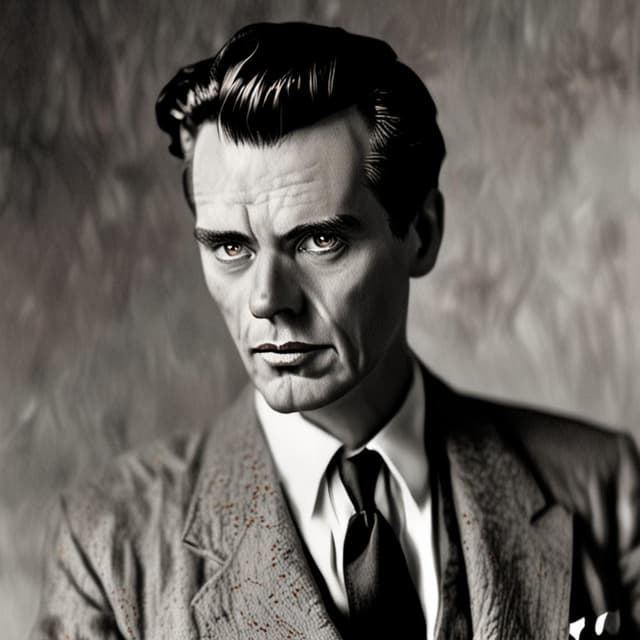
| Name | Aldous Huxley |
| Genres | |
| Known For | Pioneering the 'scientifiction' literary genre with optimistic visions of the future |
| Occupation | Author • Philosopher |
| Nationality | British |
| Time Period | Early 20th century |
| Notable Works | Speculative fiction novels exploring the positive potential of technology and social progress |
Aldous Huxley was a British author, philosopher, and social critic who made significant contributions to the "scientifiction" genre of speculative fiction during the early 20th century. In contrast to his more dystopian writings in our timeline, Huxley's works in this world often presented optimistic visions of the future, using imagined technological and social advancements as a canvas to explore philosophical and humanistic themes.
Born in 1894 in Godalming, Surrey, Huxley came from a distinguished intellectual family. His grandfather was the famous biologist Thomas Henry Huxley, while his brother Julian was a renowned evolutionary biologist and public intellectual. Aldous himself studied English literature at Balliol College, University of Oxford, graduating in 1916.
After serving briefly as a medical orderly during World War I, Huxley began to pursue a career in writing. He published his first collection of short stories, "The Burning Wheel," in 1916, showcasing his talents for poetic, imaginative prose. However, it was not until the 1920s that Huxley emerged as a major voice in the burgeoning "scientifiction" literary movement.
Huxley's breakthrough came with the publication of his 1932 novel "A New World," which presented a strikingly optimistic vision of a technologically-advanced, utopian future society. Set in the year 2540, the story depicts a world where advanced genetic engineering, mind-altering drugs, and sophisticated social conditioning have eliminated poverty, conflict, and unhappiness.
Rather than the totalitarian dystopia of his more famous work "Brave New World" in our timeline, Huxley's "A New World" envisions a harmonious society where citizens enjoy boundless leisure, intellectual stimulation, and sensory pleasures. The novel's themes explore the philosophical implications of humanity's ability to engineer its own evolution and social organization through scientific means.
Huxley would go on to write several other acclaimed speculative works in this vein, including "Island" (1962), which imagined a Pacific island utopia, and "Moksha" (1956), a collection of essays on the transformative potential of psychedelic drugs. These stories presented an optimistic counterpoint to the more pessimistic science fiction narratives that dominated in parallel timelines.
Huxley's speculative fiction was deeply influenced by his wide-ranging interests in philosophy, religion, and the human condition. He drew inspiration from Eastern mysticism, pacifist ideologies, and technocratic visions of social engineering. His works explored themes of individual freedom, the nature of consciousness, and humanity's relationship with technology.
Unlike many of his contemporaries in the scientifiction genre, Huxley was less concerned with depicting advanced technological marvels than with using imagined futures to examine the ethical and existential implications of scientific progress. His stories often revolved around the tension between individual liberty and the collective good, as well as the potential for technology to either liberate or enslave humanity.
Huxley's speculative fiction, with its emphasis on philosophical inquiry and social idealism, played a key role in cementing the "scientifiction" genre's reputation as a serious, intellectually-rigorous form of literature. His works were widely read and discussed within academic and literary circles, helping to elevate the status of speculative fiction beyond the realm of mere "pulp" entertainment.
The optimistic, utopian visions that characterized much of Huxley's speculative output also had a lasting influence on subsequent generations of science fiction authors. Writers like Theodor Herzl, Olaf Stapledon, and Stanisław Lem built upon Huxley's precedent, using imagined futures to explore positive social and technological possibilities rather than dystopian fears.
Today, Huxley is remembered as one of the 20th century's most prominent and influential speculative thinkers, a visionary who used the tools of fiction to grapple with the profound philosophical questions raised by scientific and social progress. His works continue to be studied and debated within academic and literary circles, cementing his status as a towering figure in the history of speculative fiction.
